


‘Duck run’ pest control
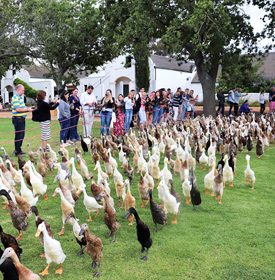
Every morning, around 1,000 long-necked ducks are let loose on a South African wine farm to gobble up insects in an environmentally friendly method of pest control that is gaining popularity. At 9:00 am the upright and flightless Indian Runner ducks charge out of their pens on a farm near the Stellenbosch wine-producing area outside Cape Town and head to work. After a rapid but brief forage for aphids, worms and snails near the homestead and restaurant, they move into the vineyards for the rest of the day. “Using the ducks instead of pesticides is obviously better for the ecology,” said Vergenoegd Low Wine Estate and farm manager, Christiaan Cloete. “When you use chemicals, you sometimes kill a lot of beneficial insects. We are trying to create a more biodiverse ecology in the vineyards.” The farm introduced the practice around 40 years ago. “It’s beginning to pick up in popularity,” he said, as farmers seek more sustainable and biologically friendly methods, including “regenerative farming” which aims to restore degraded soil. And, you might have guessed, they are ducks. Ten-plus varieties of Indian Runner Ducks, to be precise. (And, incidentally, it is only the females that quack.)
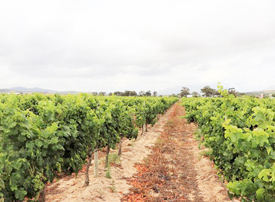
Now between five and 10 surrounding farms purchase ducks from the farm, Cloete said. There are around 890 ducks on the property with 400 hatchlings expected over the breeding season from mid-July to the end of October, Cloete said. Half will be sold and the rest will replace the more senior ducks on the farm’s own fleet. Indian Runner ducks were originally bred in Indonesia to control pests in rice paddies, said the farm’s ecology ranger. Their long necks allow them to reach pests on the raised, trellised vines. They are also handy in breaking down the manure of the 220 sheep and nearly 100 cattle that graze in the vineyard, another regenerative farming practice that leaves the soil nutrient-rich. “The more pesticides and artificial fertilizers you put onto your soil, eventually your soil will degenerate,” he said. “So by using natural methods … we are really looking after our soils, which eventually does give us a much better product at the end of the day.” When there are grapes on the vines, the ducks are kept away to avoid them being tempted by the fruit, and diverted to the four irrigation dams. As they forage there, their droppings enrich the water in a process called “fertigation.”
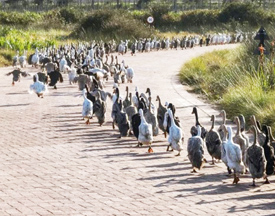
“We’re trying to set the precedent for regenerative farming. We are trying to make a use case that, if you invest the capital in the beginning, even though it’s a long, tedious process, it is worth it in the end,” she said. Since 1983, Vergenoegd has been refining their approach to ecological pest control, biodiversity, and sustainability. “We started off with chickens, but they proved not to be so efficient.” The geese, Moyes explains, are the duck’s bodyguards. “The ducks have absolutely no defense mechanism and are spooked easily. But the geese take on the role of their protectors, and go completely crazy when a mongoose or an owl approaches and scares them away. It’s a natural relationship that works very well.” The ducks seem happy with their lives, but I needed to double-check that they don’t end up on the estate’s restaurant menu at some stage. “Oh, no. That would be like eating your colleagues,” says Moyes. When their parading days are over, their ends are just as peaceful. “Eventually, they retire onto the lake’s island,” Moyes says. “And every single one will die of old age.”
Ducks and bugs Quacking up
So Daffy Duck and Elmer Fudd break into a distillery. Daffy turns to Elmer and says: “Is this Whiskey?”
Elmer says: “Yeth but not as whiskey as wobbing a bank!!”
A chicken saw a duck standing by the side of the road. The chicken called out to the duck:
“Don’t do it pal. You’ll never hear the end of it!”
What do you call 2 ducks who walk alike, act alike, and believe they are geese?
A paradox.
What do you call 2 ducks who walk alike, act alike, and believe they are geese?
A paradox.
August 27th Birthdays
1986 – Kayla Elwell, 1986 – Alexa Pena Vega, 1970 – Chandra Wilson, 1962 – Yolanda Adams
551 – Confucius, 1980 – Aaron Paul, 1993 – Blake Jenner, 1982 – Patrick Adams